
Greenfield Directory Collections by Era
No verified Greenfield-only directory run appears in the public catalogs reviewed. The practical collection is regional. Milwaukee Public Library, or MPL, keeps Milwaukee directories, metropolitan reverse directories, telephone books, and house-history sources that may include Greenfield or nearby communities. Coverage must be checked volume by volume because the old Town of Greenfield lost land through annexations and later boundary changes. A name printed under Milwaukee, West Allis, West Milwaukee, Greendale, or Hales Corners may still belong in the same family or parcel trail.
| Collection | Years | Where Held | Access |
|---|---|---|---|
| Milwaukee city directories | 1847 to present, with gaps | MPL Zeidler Room and Periodicals | Print, film, fiche, digital, and library reference help |
| Bresser’s metropolitan cross-index | 1969 to 2000 | MPL, call number 910.1 B843 | Reference collection; confirm Greenfield in each volume |
| Milwaukee telephone books | Print 1905 to present; film 1881 to 1967 | MPL Periodicals and Zeidler resources | In person; some years missing |
| Greenfield newspaper databases | Selected historic and modern dates | Greenfield Public Library | Library card or on-site access varies by database |
| WHS family-history indexes | Pre-1907 vital records and other historical files | Wisconsin Historical Society and Area Research Centers | Online index; film or copy may hold the full record |
The MPL local-history catalog gives the firmest directory dates. Name access reaches all listed years, while street and address searching begins in 1921. Print volumes cover 1848/49 through 1922 and 1923 forward in the Zeidler Room. Microfiche covers 1847 through 1860, and microfilm covers 1861 through 1960 at Periodicals. Some years are absent. A blank page or missing edition is a source gap, not proof that a Greenfield resident was gone.
Where Greenfield Directory Books Live
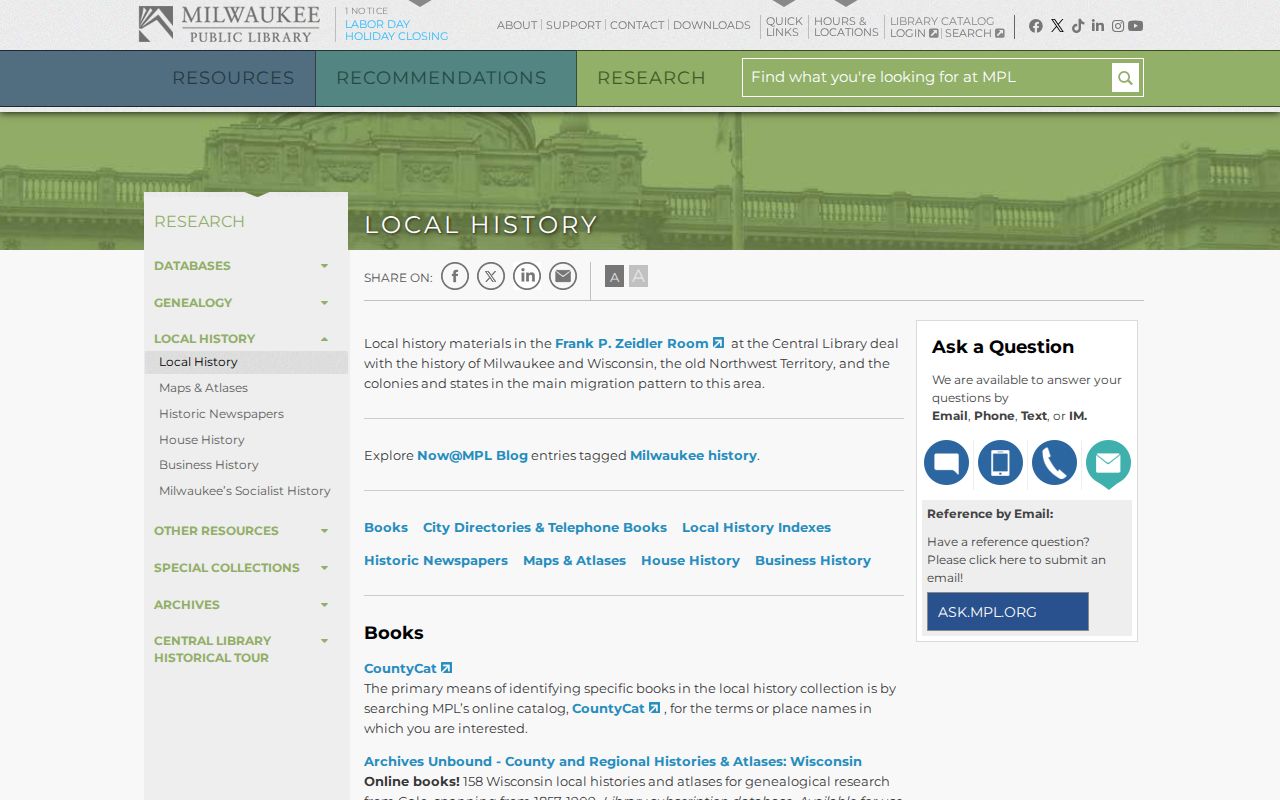
The Frank P. Zeidler Humanities Room is the main regional shelf for city directories, telephone books, atlases, maps, archives, and photographs. Film and fiche may be served from the Periodicals desk instead. Call before a visit, give staff the name, address, and approximate year, and ask whether the needed suburban volume includes Greenfield. Special collections and some architectural records need reference handling or an appointment.
The MPL local-history page is the source for its directory years, formats, reverse-index notes, and address-conversion route.
Greenfield Public Library has a different role. Its online research databases include Ancestry Library Edition for in-library use, HeritageQuest, Wisconsin newspaper archives, the Milwaukee Journal Sentinel collection, and other licensed news files. These sources can bridge a directory gap with an obituary, school item, civic notice, business announcement, or address mention. Card and on-site rules vary, so record the database title along with the article date and page.
The Greenfield Historical Society is identified in state and city planning material, but its current catalog, fees, and detailed holdings were not published in the sources reviewed. Contact it for photographs, building files, and community material. The lack of an online catalog means the collection must be asked about, not that it is empty.
Note: Ask each library for the exact edition and year before treating a missing name as a meaningful result.
Digital Routes for Greenfield Directories
MPL reports a digitized run made from its 1861 to 1960 microfilm, and Ancestry Library Edition supplies another search route at library terminals. Optical character recognition, or OCR, turns page images into searchable text, but it can mistake initials, tight type, and worn pages. Search a surname several ways, then inspect the scan and its abbreviation key. A typed search result should never replace the page image when the spelling matters.
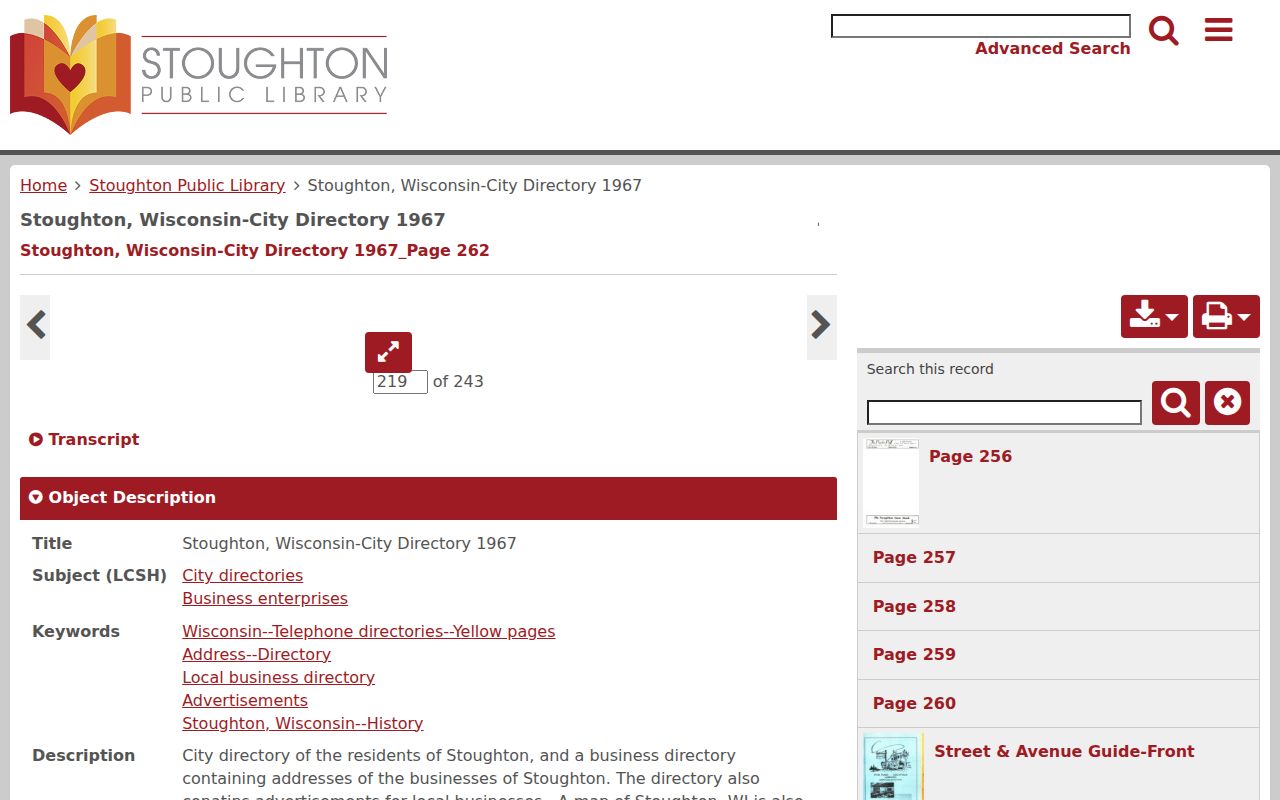
The MPL digital collection sample shows how a scanned directory presents resident and business listings, addresses, ads, and map pages. It is a 1967 Stoughton volume, not proof of Greenfield coverage.
When the digital search fails, move to film, print, and reference staff. Preserve the volume title, publisher, page, image number, and the date searched. That short citation makes the entry findable again.
Read a Greenfield Directory Entry
An alphabetic entry can hold far more than a name. It may place a spouse in parentheses, shorten an occupation, list a business address, or mark a person as a widow, boarder, roomer, owner, or renter. Practices differ by publisher and year. Photograph or copy the key at the front of that same volume before translating the marks. Do not carry a symbol’s meaning from one edition into another without checking.
| Name | Surname and given name, often with a spouse in parentheses |
|---|---|
| Work | An occupation, firm, or business address in some editions |
| Residence | House number and street as printed for that directory year |
| Household status | Publisher-specific marks for owner, renter, roomer, or boarder |
| Family clue | A spouse, widow notation, or another listed household member |
- Criss-cross directory
- A book arranged by street or telephone number, so an address can lead to a listed name.
- Householder index
- A list centered on the person treated as the household’s main listing, not a complete roster of occupants.
- Abbreviation key
- The publisher’s legend for short forms and symbols. It often sits near the front of a volume.
After finding the address entry, turn to each person in the alphabetic section. This may reveal a spouse, listed occupation, or alternate address. Keep every field tied to the printed year. A directory listing is evidence that a publisher associated a name with a place, not proof of present residence or legal ownership.
Greenfield’s 1930 Address Trap
An old street number may vanish even when the household stayed put. MPL points researchers to a 1930 Milwaukee street name and number conversion supplement before they search earlier volumes. The Milwaukee County Historical Society is reported to have conversion PDFs, but a stable official file link was not confirmed. Ask MPL staff for the supplement and record both the old and new forms of the address.
Greenfield adds a second layer. The community began as the much larger Town of Greenfield, then changed through annexations and the incorporation of nearby places. Earlier evidence may sit under Milwaukee or another current municipality. Search the historic label and the current label, but use deed descriptions, tax keys, and dated maps to show they refer to the same parcel.
Insider tip. Keep separate columns for the address as printed, its converted form, the jurisdiction, and the year. Never silently replace the old wording.
Reverse Greenfield Directory Trails
Bresser’s Cross-Index Directory covers metropolitan Milwaukee and suburban communities from 1969 through 2000. MPL assigns it call number 910.1 B843. Its reverse arrangement lets an address lead to a listed name, a useful shift when the person’s spelling is unknown. MPL’s broader house-history instructions say address lookup begins in 1921, but that does not mean every Greenfield street appears in every regional book.
Confirm the volume’s geographic coverage first. Then scan the addresses just before and after the target, since number changes and indexing errors can put a listing out of order. Telephone books provide a second clue: MPL has print Milwaukee volumes from 1905 forward and microfilm from 1881 through 1967, with gaps. They can support an address match, but an unlisted phone or suburban coverage gap explains many blanks.
Trace Greenfield Families by Directory
A sound family-history search treats each city directory as a dated snapshot. Begin with a known name or address and work one edition at a time. Directories fill years between federal censuses, while a census can add household relationships and birthplaces that the short directory line omits. Ownership requires a separate assessor or deed check.
- Find the person in the alphabetic section and copy the entry exactly, including initials and symbols.
- Follow the name forward and backward, noting the first appearance, last appearance, address changes, and occupation changes.
- For 1921 or later, check the street section. For 1969 through 2000, test the Bresser cross-index where Greenfield is covered.
- Pair the dated entries with available federal census years, then compare relatives and ages rather than relying on the name alone.
- Use newspapers, obituaries, probate, cemetery records, and Wisconsin historical indexes to explain a move or disappearance.
A missing listing can mean a move, death, publication gap, changed spelling, changed jurisdiction, or a choice not to be listed. Greenfield Library’s newspaper files can supply the event date. The Wisconsin Historical Society family-history search adds pre-1907 vital indexes and statewide material. Compare dates before joining records into one life story.
Greenfield House History Companions
A directory volume becomes stronger when it is paired with a source created for a different reason. MPL’s house-history collection combines address directories from 1921 forward with assessments, premises records from 1888 through 1980, maps, photographs, and finding aids. Fire-insurance atlases span the mid-1870s through the 1960s. Plat maps and city maps can place a road or lot in its period setting.
The MPL house-history instructions explain how those sources fit together. A premises record can date work at a building; a directory can name a listed occupant; a deed can name transfer parties. None alone proves that every household member lived there. For modern owner and address research, use the Greenfield street directory workflow instead of extending an old book beyond its date.
Greenfield Directory Research Timeline
These milestones show when the regional tools change. They mark the source’s coverage, not a resident’s move date.
| 1847 | MPL’s regional Milwaukee city directory run begins. |
|---|---|
| 1881 | MPL’s Milwaukee telephone-book microfilm coverage begins. |
| 1921 | MPL documents street and address directory searching from this point. |
| 1930 | The address-conversion supplement becomes vital for earlier Milwaukee numbers and names. |
| 1969 to 2000 | Bresser’s metropolitan and suburban cross-index provides reverse searching. |
Greenfield-specific inclusion still needs confirmation in the chosen volume. No official source reviewed established a first Greenfield-only directory year. State the regional year honestly, then ask Greenfield Library, MPL, CountyCat, or the historical society about separate suburban issues.