
Greenfield Previous-Resident Sources
Greenfield address history spans municipal, county, library, state, and federal collections. Each source answers a different question. Deeds name transfer parties, the assessment roll identifies the current assessed owner, reverse directories connect a printed address to names, and a census describes a household for its enumeration date. Begin with the source closest to the target year.
| Source | Years covered | Where held | Address-history evidence |
|---|---|---|---|
| Milwaukee County deed index | Modern deed search from April 1, 1948; older books to 1835 | Register of Deeds and Tapestry | Grantor, grantee, instrument date, parcel and legal description |
| Bresser cross-index | 1969-2000 | Milwaukee Public Library | Reverse address-to-name clues, subject to volume coverage |
| Milwaukee city directories | 1847-present; address search from 1921 | MPL Zeidler and Periodicals | Names, addresses, household and business notes |
| Federal census | Released schedules under the 72-year rule | National Archives and library databases | Household members, ages, birthplaces, and area context |
| Greenfield permits | Public BSA route; historical cutoff not stated | Inspection Services or city request | Work dates, project descriptions, and permit contacts |
For a recent question, start with the Greenfield property search and the deed index. For a mid-century or older household, ask which directory volume covers suburban Greenfield before assuming the Milwaukee city run applies. The table is a coverage plan, not a claim that every source includes every Greenfield address.
Start Greenfield Past-Resident Records
The present parcel supplies the stable bridge into older records. Search by House No and Street Name, then save the displayed owner, situs address, and tax key. Situs means the parcel's physical address. The mailing address is where tax notices go and may belong to an agent, post-office box, or another city.
Assessment data on the portal are marked current May 7, 2026. Preserve that date and the applicable roll year. An assessment is not a sale price, and the assessed owner is not proof of every resident. If the online form fails, the Greenfield Assessor offers office and open-book access at City Hall, with telephone help at 414-329-5340.
Note: Keep situs, mailing address, tax key, and legal description in separate columns throughout a Greenfield previous-residents search.
Trace Greenfield Resident Deeds Backward
The Milwaukee County Register of Deeds search carries the parcel from today's assessed owner into recorded title history. A deed proves a recorded transfer, not that the buyer moved in. Confirm the legal description and instrument before adding either party to a previous-residents timeline.
- Copy the current assessed owner, tax key, and legal description from Greenfield's roll.
- Search that owner as grantee and confirm the purchase deed against the parcel and recording date.
- Take the seller's name from the deed, then search that seller as grantee in an earlier period.
- Repeat while preserving spouses, estates, trusts, business entities, name variants, and document numbers.
- When the modern search ends, use book, page, or document-number indexes and ask Register of Deeds staff for the correct older series.
- Grantor and grantee
- The grantor transfers an interest; the grantee receives it.
- Chain of title
- The sequence of recorded transfers tied to the same property.
- Legal description
- The lot, block, subdivision, CSM, or metes-and-bounds wording that identifies land more reliably than an old street label.
The real-estate records instructions document mail, telephone, appointment, and walk-in routes. The office is at 901 N. 9th Street, Room 103, Milwaukee, and the real-estate line is 414-278-4001. Tapestry is a paid remote index; certified copies still come from the custodian.
The recorder's search landing page is the visual starting point for a backward chain:
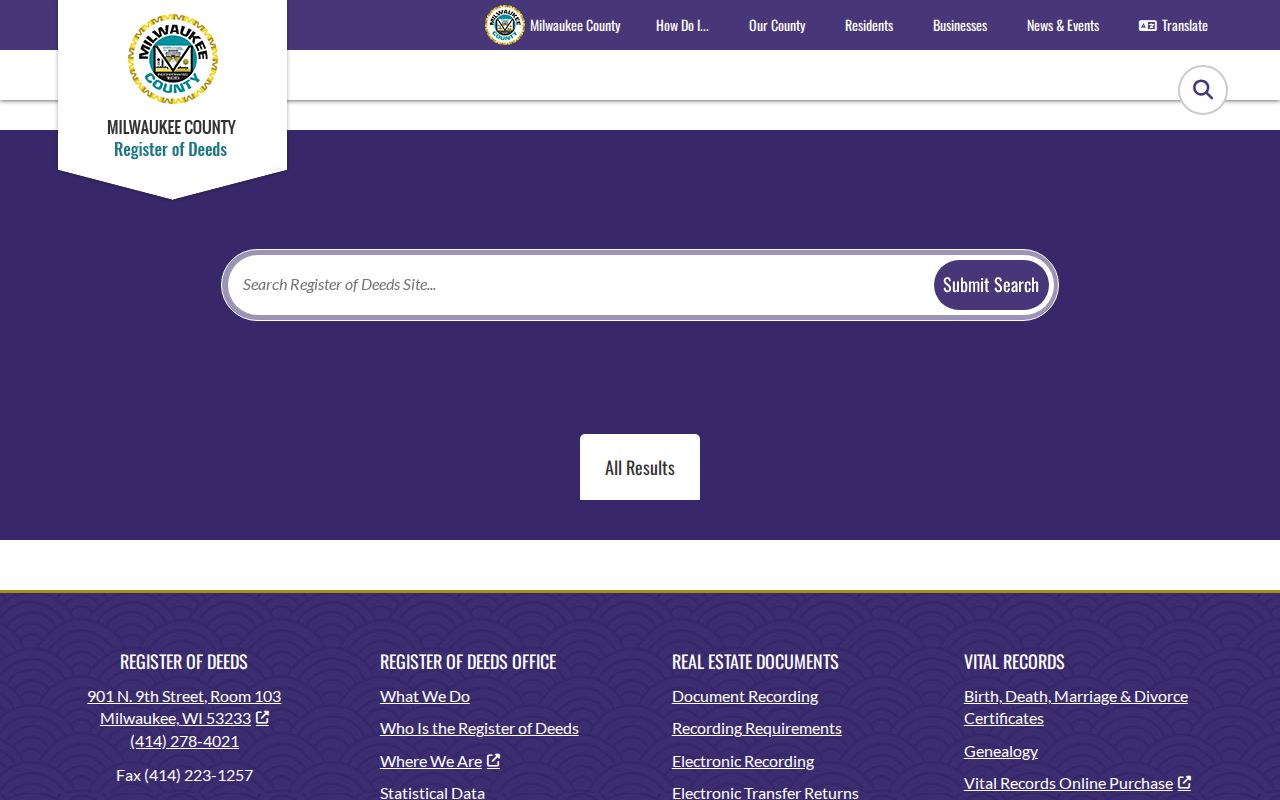
Use the page to reach the index, then record every document number needed for a copy or staff-assisted historical search.
Greenfield Resident Deeds Change Era
Milwaukee County's title coverage is deep, but the search method changes. All recordings are digitized from 1962 forward, and deeds from April 1, 1948 to the present fit the modern group. Deeds from 1835 through March 31, 1948 require older document-number or book-and-page methods. Digital Reel adds a tax-key grantor/grantee bridge from roughly the 1920s through 1989.
This cutoff is an insider tip for Greenfield previous-residents work. A blank modern query does not end the chain. Bring the current tax key, full legal description, earliest known deed, known name spellings, and a date range to a historical appointment. Ask which tract, book, reel, or plat index covers the parcel.
Note: April 1, 1948 changes the deed-search route, not the existence of Milwaukee County's earlier recorded title history.
Convert Greenfield Resident Addresses
A street string can fail while the parcel survives. MPL points researchers to a 1930 Milwaukee street number and name conversion supplement before earlier address searches. That tool is especially important when a directory suddenly stops recognizing a house number. Greenfield may also sit in suburban or community volumes rather than a given Milwaukee city volume.
Try the tax key and legal description when a historical street name fails. Greenfield's CSM, subdivision, and condominium document search can identify recorded development structure, while the county deed system accepts subdivision, lot, block, parcel, and metes-and-bounds fields. CSM means certified survey map.
Boundary history adds another layer. Older records may say Town of Greenfield, Milwaukee, West Allis, West Milwaukee, Greendale, or Hales Corners, depending on date and location. Search both the former place name and the custodian that created the record.
MPL Traces Greenfield Past Residents
The Milwaukee Public Library house-history guide combines address directories, assessments, premises records, maps, photographs, and architecture files. Some named assessment and premises collections are strongest for City of Milwaukee buildings, so ask staff whether the exact Greenfield parcel falls within a volume or finding aid.
MPL's Zeidler Humanities Room holds directories, telephone books, atlases, maps, archives, and historic photographs. Call 414-286-3061 with the normalized address, alternate forms, tax key, and target years. Greenfield Public Library adds licensed newspaper and genealogy databases, including onsite or card-based resources whose access rules vary.
The official MPL workflow shows how these sources fit together:
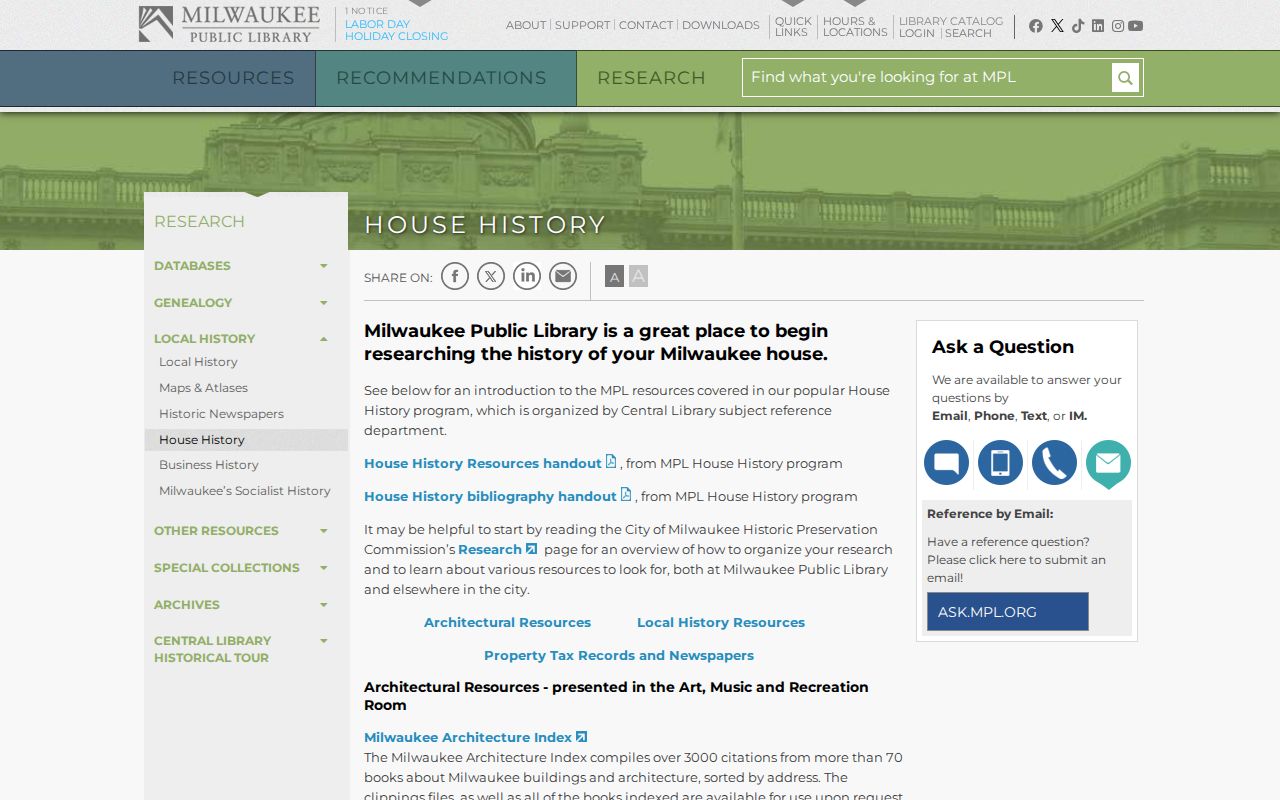
The page is a method guide, not proof that every Milwaukee collection covers every Greenfield address.
Greenfield Past Residents Between Deeds
Ownership is only half the story. An address directory can list occupants who never appear in title records. MPL documents name access across its Milwaukee directory run and address searching from 1921, while Bresser's metropolitan and suburban cross-index covers 1969-2000. Confirm Greenfield coverage in the chosen volume before reading a blank as an empty house. The collections themselves are detailed on the Greenfield city directories page.
Build a dated sequence: check the address section, copy every name, inspect each alphabetic entry, then compare the nearest released federal census. The census may add household relationships, ages, and birthplaces. Directory publication and census enumeration dates differ, so an apparent overlap can be a normal move between snapshots.
- Record the address exactly as printed for each directory year.
- Pair the name with the alphabetic entry and keep spouse, widow, roomer, or business notes distinct.
- Compare the closest released census schedule, without forcing its household onto another year.
- Use newspapers, obituaries, probate, cemetery records, and pre-1907 Wisconsin indexes to explain later moves or deaths.
Greenfield Library's newspaper databases can bridge missing directory years with obituaries, school notices, civic items, and property news. Probate can explain a deed from an estate. A cemetery or vital index is a clue; restricted certified records still require the proper official request route.
Lawful use. Greenfield previous-residents research supports house history, genealogy, and estate work. Never use a record trail to monitor, threaten, expose, or harass a living person.
Greenfield Resident Records in Permits
Building records can mark construction, additions, alterations, occupancy changes, and inspections. Greenfield links to BSA building-record categories, though the live public result fields and historical cutoff were not exposed in the research. Treat a permit contact as a role tied to work, not automatic proof of residence.
When the portal does not answer the question, contact Inspection Services or make a focused city records request. Supply the exact address, date range, permit type, and fields sought. Library newspapers can corroborate dated work. The 2023 citywide revaluation also provides an assessment marker, but an assessed value is not a transaction price.
Konkel Park offers a local example of why dates matter: official material places parcel acquisition in 1979/80 and softball development in 1988/89. The same discipline applies to a private address. Separate land acquisition, construction, assessment, and occupancy events instead of collapsing them into one date.
Greenfield Previous Residents Are Not Owners
A deed chain answers who held a recorded interest. It does not list each person who slept, received mail, or spent part of a year at the address. Conversely, a directory entry can identify an occupant without proving title. Mailing addresses, permit applicants, mortgage parties, and obituary addresses carry their own narrower meanings.
Maintain a source-type label beside every name: assessed owner, grantor, grantee, directory occupant, census household member, permit contact, obituary subject, or probate party. Confidence grows when dates, tax keys, and legal descriptions align across independent sources. One unexplained name hit should remain a lead.
If a deed image raises a legal ownership issue, obtain the official copy and consult a qualified title professional or attorney. Library and index work can reconstruct history, but it is not a title opinion.